IBS Construction in Malaysia: The New Standard for Industrial Buildings in 2026
IBS construction in Malaysia is reshaping how industrial buildings are built in 2026.
If you have driven past any major industrial zone in the Klang Valley, Johor Bahru, or Penang recently, you may have noticed something different. Factories, warehouses, and logistics hubs are going up faster than ever before, and they look remarkably uniform in their structure. That is not a coincidence. Across Malaysia and much of Southeast Asia, industrial developers are making a deliberate shift toward Industrialised Building System, better known as IBS construction. And in 2026, that shift has moved well beyond a trend. It has become the new standard for industrial building projects of almost every scale.
This article examines why industrial developers, contractors, and building owners across Malaysia are increasingly adopting IBS construction, what makes it highly suitable for industrial projects, and what the sector can expect as we move further into 2026.

What Is IBS Construction and Why Does It Matter for Industrial Buildings?
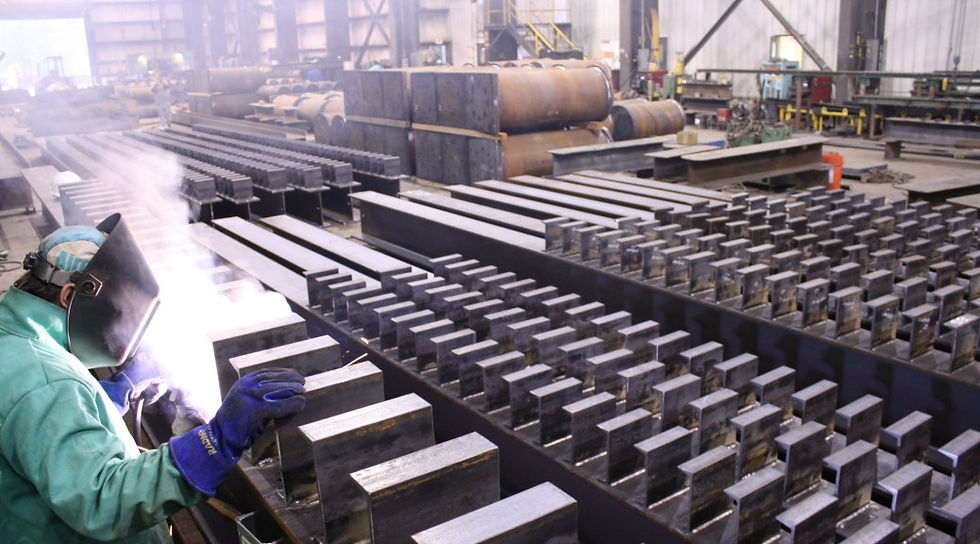
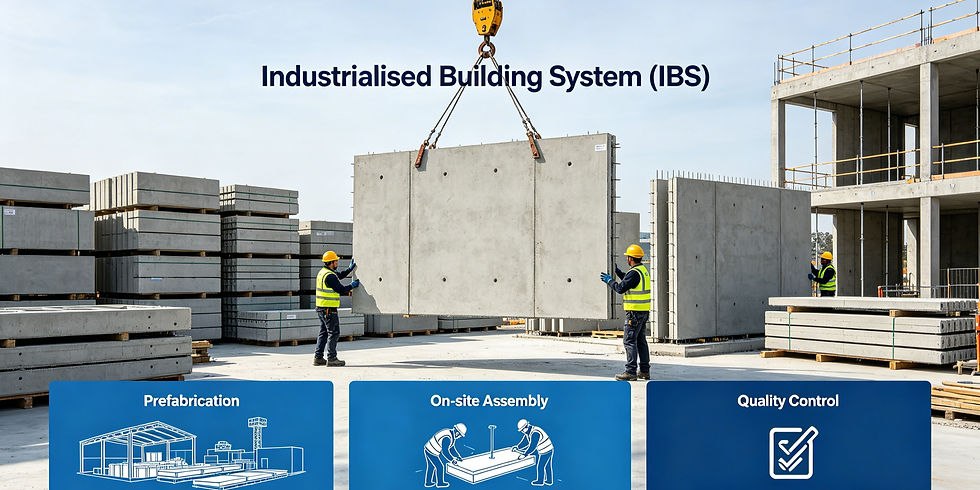
IBS, or Industrialised Building System, refers to a construction technique where components such as columns, beams, walls, slabs, and staircases are manufactured off-site in a controlled factory environment and then transported to the project site for assembly. This stands in contrast to conventional construction, where most structural work is cast and built on-site using timber formwork, manual labour, and significant quantities of wet concrete.
For industrial buildings specifically, IBS construction offers a uniquely compelling proposition. Industrial structures, whether they are manufacturing plants, cold storage facilities, fulfilment centres, or heavy warehouses, tend to share certain characteristics. They are often large in footprint, relatively repetitive in their structural layout, and highly sensitive to construction timelines. All three of these characteristics align almost perfectly with what IBS construction does best.
In Malaysia, IBS construction has been actively promoted by the government through CIDB Malaysia (Construction Industry Development Board) for over two decades. But the adoption rate in the industrial sector has accelerated sharply in recent years, driven by a combination of policy push, labour market pressure, and growing developer confidence in the system's performance track record.
The Key Reasons Industrial Buildings Are Adopting IBS Construction in 2026
1. Speed of Construction Has Become Non-Negotiable
Industrial tenants and owners operate in a commercial environment where time genuinely equals money. A warehouse that takes an extra six months to complete is not just an inconvenience. It is potentially millions of ringgit in lost rental income, delayed supply chain operations, or missed production targets. IBS construction dramatically compresses construction timelines because the structural components arrive on-site ready to assemble, rather than being formed, cast, and cured in place.
In typical industrial building projects in Malaysia, the use of IBS construction has been shown to reduce overall construction time by 30 to 50 percent compared to conventional methods. For a large logistics facility, that can translate to being operational months ahead of schedule. In the fiercely competitive industrial property market of the Klang Valley and Johor, that kind of advantage is enough to swing major leasing decisions.
2. Labour Shortages Are Driving the Shift to IBS Construction Malaysia
Malaysia's construction sector has faced persistent labour shortages for several years. The heavy reliance on foreign workers, combined with tightening immigration policies and rising labour costs, has created real pressure on conventional construction methods that are inherently labour-intensive. IBS construction significantly reduces the volume of on-site labour required because most of the skilled work happens in the factory, not on the building site.
For industrial building projects, which often require large workforces to meet tight deadlines, this is particularly significant. Developers who struggled to mobilise sufficient workers for conventional builds are finding that IBS construction allows them to complete projects with smaller, more specialised site teams. This is not just a cost saving. It is a risk reduction, because projects are less vulnerable to workforce disruptions and productivity losses.

3. Quality Control in Industrial Building IBS Is Far More Consistent
Industrial buildings carry heavy structural loads. They house forklifts, racking systems, heavy machinery, and sometimes entire production lines. The structural integrity of every column, beam, and slab matters enormously. One of the persistent challenges with conventional on-site construction is that quality is heavily dependent on the skill and diligence of the workers who happen to be on-site on a given day.
IBS construction eliminates much of that variability by moving structural fabrication into a factory environment where temperature, moisture, mix ratios, and curing processes can be precisely controlled and monitored. The result is a level of dimensional accuracy and structural consistency that is genuinely difficult to replicate on an open construction site, particularly during Malaysia's monsoon season when on-site conditions can be unpredictable.
For industrial tenants who need to install sensitive equipment on precise floor levels, or who require specific load ratings across large spans, this consistency is not just a preference. It is a technical requirement, and IBS construction in Malaysia is increasingly positioned to meet it reliably.
4. Cost Predictability Over the Long Term
The upfront cost of IBS construction can be higher than conventional methods for smaller projects, a fact that has historically slowed adoption in certain segments of the market. However, for industrial buildings, the economics look quite different. The sheer scale and structural repetition of most industrial builds means that the factory production model of IBS delivers genuine economies of scale. Once the moulds and production lines are set up for a project, producing additional units becomes progressively more cost-efficient.
More importantly, the total cost calculation for industrial building IBS needs to account for more than just material and labour costs. When you factor in the savings from reduced construction time, lower defect rectification costs, reduced on-site waste disposal, and lower long-term maintenance requirements, the total cost of ownership often favours IBS construction significantly. This long-term view is exactly how industrial property developers and institutional investors tend to evaluate building quality.
5. Environmental and Regulatory Alignment in 2026
Malaysia's construction regulations have moved steadily in the direction of sustainability and waste reduction. The government's National Construction Industry Master Plan and various state-level green building incentives have created a policy environment that actively rewards IBS construction adoption. In 2026, industrial developers seeking green building ratings or environmental certifications will find that IBS construction aligns naturally with those goals.
Because components are fabricated in controlled factory conditions, material waste is substantially lower than conventional construction. There is less concrete spillage, less timber formwork waste, and less construction debris to manage on-site. For industrial sites that need to manage environmental impact assessments or comply with local authority conditions, this is a meaningful advantage. IBS construction in Malaysia is increasingly being positioned not just as an efficient building method, but as a responsible one.
IBS Construction Malaysia: The Industrial Sector Takes the Lead
Across Malaysia, the industrial property sector has emerged as one of the strongest drivers of IBS construction adoption. The growth of e-commerce logistics, semiconductor manufacturing, data centres, and cold chain infrastructure has created enormous demand for industrial space, and developers have discovered that IBS construction is ideally suited to meeting that demand at speed and scale.
In the Klang Valley, major industrial parks in Shah Alam, Subang, and Sepang have seen a surge in IBS-built facilities. In Johor, the ongoing industrial development tied to data centre investments and cross-border manufacturing activity has generated projects where IBS construction has been specified from the outset. Penang's industrial corridor, anchored by semiconductor and electronics manufacturing, has similarly seen IBS construction move from a novelty to a norm.
What is notable about 2026 is that IBS construction is no longer being adopted primarily by the largest developers with the most sophisticated procurement teams. Mid-sized industrial developers, smaller factory owners, and even owner-occupiers are now specifying IBS construction as a matter of course. The supply chain for IBS components in Malaysia has matured to the point where pricing is competitive and delivery timelines are reliable, which has removed the two biggest historic barriers to wider adoption.

Challenges That Still Exist in Industrial Building IBS Adoption
While the momentum behind IBS construction in the industrial sector is strong, it would be misleading to suggest that adoption is without friction. Some genuine challenges remain, and understanding them is important for anyone planning an industrial building project in Malaysia.
The first is design flexibility. IBS construction is optimised for structural repetition, and while the range of available components has expanded considerably, highly customised or architecturally complex industrial facilities may still find that conventional construction offers more design freedom. For standard warehouses and factories, this is rarely an issue. But for specialised research facilities or industrial buildings with unusual structural requirements, the design team may need to work more carefully with IBS component manufacturers early in the process.
The second is the availability of skilled erection crews. While IBS construction reduces the need for large on-site workforces, it does require specialised teams trained in the correct assembly of precast components. As IBS adoption has grown, the availability of these skilled erection teams has improved, but demand in some periods can outstrip supply, which requires careful project scheduling.
The third is the upfront cost of design coordination. IBS construction requires much more thorough design resolution before production begins, because modifications to prefabricated components once they are in production or on-site are expensive. Projects that are not well-managed at the design coordination stage can encounter costly changes. This is why having experienced construction management oversight is so important for industrial building IBS projects.
What the Future Looks Like for IBS Construction in Industrial Buildings
Looking ahead, IBS construction in Malaysia is likely to become even more dominant in the industrial sector over the coming years. Several converging forces point in this direction. The continuing growth of industrial property demand, driven by Southeast Asia's expanding manufacturing base and logistics infrastructure, means that construction speed and scalability will remain premium values. IBS construction delivers both.
At the same time, government policy in Malaysia continues to push in the same direction. CIDB's IBS Score requirements for public projects have been gradually tightened, and there are clear signals that private sector requirements will follow. Developers who have already built their procurement and project management capabilities around IBS construction will be well positioned as these requirements expand.
The integration of digital tools, particularly Building Information Modelling (BIM), with IBS construction workflows is also advancing rapidly in Malaysia. The combination of BIM-driven design and IBS fabrication creates a virtuous cycle in which design accuracy improves the quality of fabricated components, which in turn makes on-site assembly faster and more predictable. For industrial buildings, where structural precision directly affects operational efficiency, this convergence is significant.
Industrial building IBS is not simply a construction technique anymore. It is becoming the backbone of how Malaysia builds its industrial infrastructure, and 2026 may well be looked back on as the year when that transition became irreversible.
Frequently Asked Questions About IBS Construction Malaysia
Q1: Is IBS construction suitable for all types of industrial buildings in Malaysia?
IBS construction is well-suited to the majority of industrial building types, including warehouses, factories, logistics hubs, and light manufacturing facilities. Its performance is strongest where structural layouts are relatively repetitive, which describes most standard industrial buildings. For highly customised facilities with complex structural requirements, a hybrid approach combining IBS components with conventional construction methods is often used. It is advisable to engage a construction management team with IBS experience early in the design process to determine the most appropriate specification for your specific project.
Q2: How much faster is IBS construction compared to conventional construction for industrial buildings?
The time savings vary depending on project scale, complexity, and site conditions, but IBS construction typically reduces overall construction duration by between 30 and 50 percent compared to conventional methods for comparable industrial building projects. The savings come from the elimination of on-site casting and curing time, faster assembly of prefabricated components, and the ability to carry out factory production and site preparation works concurrently. For developers and tenants who are working to tight operational timelines, this advantage is often the single most compelling reason to specify IBS construction.
Q3: Does using IBS construction in Malaysia affect the long-term durability of industrial buildings?
When properly designed, specified, and installed, IBS construction produces industrial buildings that are at least as durable as conventionally built structures, and often more so. The factory-controlled manufacturing process results in components with more consistent concrete quality and reinforcement placement than is typically achievable on an open construction site. Proper joint design and waterproofing detailing are important considerations in IBS industrial buildings, and an experienced construction management team will ensure these are addressed correctly. Buildings constructed using IBS methods in Malaysia have been performing well for decades, providing strong evidence of their long-term durability.
Where to Get Trusted Contractor in Malaysia for IBS Construction
We provide expert oversight and installation for high-quality construction works, including industrial buildings, commercial facilities, and full-scale structural projects. Our services are suitable for both Residential Renovation in Malaysia and commercial projects, including IBS Construction Malaysia, ensuring long-term performance without compromising design.
Whether you are planning a new Industrial Building IBS project, a commercial upgrade, or a complex structural development, each project is tailored to your specific needs, providing the best combination of function, safety, and technical performance. Our coverage spans the entire country, including Kuala Lumpur, Selangor, Klang Valley, Johor Bahru, Penang, Malacca (Melaka), Seremban, Negeri Sembilan, Perak, Pahang, Kuantan, Kelantan, Terengganu, Perlis, Alor Setar Kedah, and East Malaysia's Sabah and Sarawak.
We also serve regional clients across Southeast Asia (SEA), including Singapore, Thailand, Indonesia, Vietnam, Cambodia, the Philippines, Brunei, Myanmar, and beyond. From industrial warehouses and factory builds to hotels, resorts, or public infrastructure, our team integrates modern construction practices and IBS Construction 2026 expertise to deliver solutions that meet the highest standards for Industrial Building IBS projects in Malaysia and the region.
For enquiries, email us at info@aathaworld.com or call/WhatsApp +(60)11-7001 1003 (Mon–Fri) or +(60)11-7003 1003 (Sat, Sun & Public Holidays) to find the best construction management solutions in Malaysia.