
Aluminium Louvers: Improve Ventilation and Solar Shading for Your Building in Malaysia
In Malaysia's tropical climate, where heat, humidity, and intense sunlight are year-round realities, aluminium louvers have become one of the most practical and architecturally versatile solutions for improving ventilation and solar shading in both residential and commercial buildings.
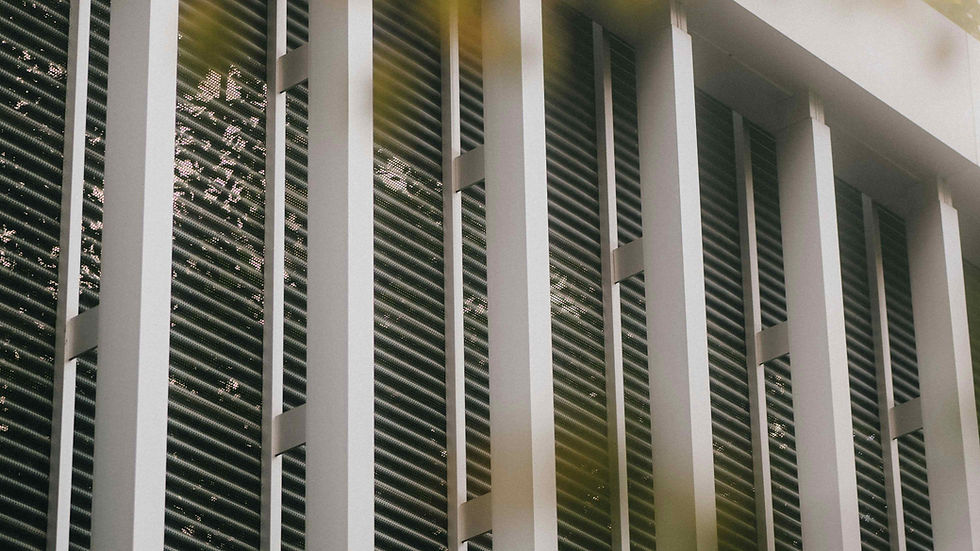
What Are Aluminium Louvers and Why Do They Matter?
Aluminium louvers are angled, slatted panels typically installed on walls, rooftops, windows, or facades to allow controlled airflow while blocking direct sunlight and rain. Made from lightweight yet durable aluminium alloy, they combine structural resilience with low maintenance — a pairing particularly valued in Malaysia's high-humidity environment.
Unlike traditional fixed vents or louvred timber screens, modern aluminium louvers can be engineered with adjustable blades, custom powder-coat finishes, and precise blade angles suited to the sun's path across a specific building orientation. This adaptability has made them a staple in building envelope design across the region.
40%
Potential reduction in solar heat gain
25+
Years service life, properly maintained
100%
Recyclable aluminium material
How Aluminium Louvers Improve Ventilation in Malaysian Buildings
Natural ventilation is a cornerstone of tropical architecture, and a well-designed aluminium ventilation louver system can significantly enhance passive airflow within a building. By directing wind pressure through strategically positioned blade angles, louvers create a stack effect that draws warm, stale indoor air upward and outward while fresh outdoor air enters from lower openings.
This cross-ventilation principle reduces reliance on mechanical air conditioning, which translates directly into lower energy consumption — a meaningful consideration for property owners in Kuala Lumpur, Penang, and Johor Bahru, where cooling costs represent a substantial portion of monthly operating expenses.
For industrial and commercial facilities such as warehouses, manufacturing plants, and parking structures, aluminium louvers in Malaysia are frequently deployed along sidewalls and roof ridges to manage internal heat loads. The louvers permit air movement while protecting interiors from wind-driven rain, maintaining a functional and comfortable working environment without the cost of full HVAC coverage across large floor areas.
"A correctly specified ventilation louver system can reduce mechanical cooling loads by meaningful margins — particularly relevant in Malaysia, where buildings operate in full-load cooling conditions for most of the year."

Solar Shading: The Critical Role of Aluminium Louvers in Malaysia's Tropical Climate
Malaysia sits between 1° and 7° north of the equator, meaning the sun reaches near-vertical angles during midday and passes through both the north and south aspects of a building across the year. Managing solar heat gain through the building envelope is therefore not a secondary consideration — it is fundamental to energy performance and occupant comfort.
Aluminium solar shading facades fitted with louver blades can intercept direct solar radiation before it reaches glass or wall surfaces. When the blade angle, depth, and spacing are calculated against the building's latitude and orientation, a louver system can block direct sun during peak hours while still admitting sufficient diffuse daylight to reduce artificial lighting demands.
This dual function — reducing heat gain while preserving daylighting quality — is what distinguishes a thoughtfully designed aluminium louver facade from a simple external screen. For architects and developers working on green building certifications such as GBI (Green Building Index) Malaysia or the BCA Green Mark in Singapore, the solar shading performance of external louver systems contributes measurable credits toward certification targets.
Fixed vs. Adjustable Blade Louvers
Fixed-blade aluminium louvers are the standard solution for most commercial and industrial applications. The blade angle is set during fabrication to match the building's orientation and the sun's typical path, and they require no ongoing adjustment or mechanical servicing. Their simplicity is also their strength: there are no moving parts to wear, and the assembly can be powder-coated in virtually any colour to integrate with the building's architectural palette.
Adjustable-blade louver systems, sometimes referred to as operable or motorised louvers, allow occupants or building management systems to change the blade angle throughout the day. While the installation cost is higher, the payoff is a facade that can optimise for morning and afternoon sun positions separately, and can be opened fully during mild weather to maximise natural ventilation. These systems are increasingly specified for premium office towers, hotel facades, and high-end residential developments across Klang Valley and the wider Selangor corridor.

Material Advantages: Why Aluminium Is the Preferred Choice
Aluminium's dominance in louver fabrication is not incidental. Its strength-to-weight ratio allows long blade spans without intermediate supports, keeping facade sightlines clean. It does not rust, which is essential in coastal regions such as Penang and East Malaysia's Sabah and Sarawak where saline air would rapidly degrade steel alternatives.
Modern powder-coat and anodised finishes give aluminium louvers exceptional UV and weather resistance, maintaining colour integrity even under sustained tropical sunlight. The material is also fully recyclable, supporting project sustainability goals and end-of-life material recovery. When lifecycle cost is assessed — factoring in maintenance, painting, and replacement frequency — aluminium consistently outperforms timber, steel, or uPVC alternatives over a 20-to-30-year building lifespan.
Applications Across Residential and Commercial Projects in Malaysia
The versatility of aluminium louvers means they appear across nearly every building typology in Malaysia. In residential settings, they are used as feature screens for balconies and car porches, as window hoods to deflect rain without blocking breezes, and as ventilation panels in utility areas and roof spaces. Their clean, contemporary aesthetic suits both modern minimalist homes and more traditional kampung-inspired architectural language when finished in appropriate tones.
In commercial projects, aluminium louver facades are commonly seen on multi-storey car parks, where they provide the required fire ventilation performance while giving the structure a considered architectural finish. Data centres, telecommunications buildings, and mechanical plant rooms in Malaysia also rely heavily on aluminium ventilation louver systems to maintain the precise airflow rates required for equipment cooling, while keeping out insects, debris, and water ingress.
Across Southeast Asia more broadly — including Singapore, Indonesia, and Vietnam — the same principles apply. Regional climate similarities mean that aluminium louver specifications developed for Malaysian conditions translate well across borders, making them a natural choice for regional developers and contractors managing projects in multiple markets simultaneously.
Selecting the Right Aluminium Louver System for Your Project
Choosing the correct aluminium louver system requires more than a catalogue selection. Key parameters include the free area percentage — the proportion of the louver face that is open to airflow — which directly governs ventilation performance. Blade depth, pitch, and the profile geometry of each slat determine the louver's rain-defence class, an important variable for Malaysian conditions where rainfall intensity can exceed 100mm per hour during monsoon events.
The structural framing system, fixing method, and thermal break details also warrant careful attention on projects where condensation control or facade movement from thermal cycling is a concern. Working with experienced contractors and suppliers who can provide certified test data for wind load, water penetration, and airflow performance ensures that the specified system will deliver its intended results over the building's service life.

Frequently Asked Questions
What is the typical lifespan of aluminium louvers installed in Malaysia's tropical climate?
With proper powder-coat or anodised finishing and basic periodic cleaning, aluminium louvers in Malaysian conditions typically last 20 to 30 years or more before any structural replacement is needed. The primary maintenance task is washing accumulated dust and biological growth from blade surfaces, which preserves both appearance and airflow efficiency. Coastal installations in areas such as Penang or Kota Kinabalu may benefit from more frequent washing due to salt-laden air.
Can aluminium louvers be integrated into green building certification programmes in Malaysia?
Yes. Aluminium louver systems contribute to several credit categories under the Green Building Index (GBI) Malaysia, particularly those related to energy efficiency, indoor environmental quality, and innovation in design. Solar shading performance data from louver suppliers can be used to model reduced solar heat gain coefficients for the building facade, which feeds directly into energy simulation models used for GBI and BCA Green Mark submissions.
Is it possible to retrofit aluminium louvers onto an existing building rather than specifying them in new construction?
Retrofit installation is entirely feasible and is in fact a common application in Malaysia, particularly for existing commercial buildings seeking to improve solar shading performance without a full facade replacement. The key considerations are the structural capacity of the existing facade to carry the additional louver framing, access arrangements for installation and future maintenance, and ensuring the fixing method is compatible with the existing wall construction. A site survey and structural assessment by a qualified contractor will confirm feasibility and guide the specification process.
Where to Get a Trusted Aluminium Louver Contractor for Ventilation in Malaysia
We provide expert oversight and installation for high-quality building facade works, including aluminium louvers for ventilation and solar shading, curtain wall systems, architectural screens, and full building envelope upgrades. Our services cover both commercial and industrial aluminium louver projects in Malaysia and residential facade solutions, ensuring long-term performance without compromising design.
Whether you need an aluminium louver system for a commercial facade in Malaysia for a large-scale development or a solar shading aluminium louver installation for a residential property, each project is tailored to your specific site conditions, orientation, and performance requirements, delivering the best combination of airflow efficiency, weather protection, and architectural finish.
Our coverage spans the entire country, including Kuala Lumpur, Selangor, Klang Valley, Johor Bahru, Penang, Malacca (Melaka), Seremban, Negeri Sembilan, Perak, Pahang, Kuantan, Kelantan, Terengganu, Perlis, Alor Setar Kedah, and East Malaysia's Sabah and Sarawak. We also serve regional clients across Southeast Asia (SEA), including Singapore, Thailand, Indonesia, Vietnam, Cambodia, the Philippines, Brunei, Myanmar, and beyond.
From car park ventilation facades and industrial plant screens to hotel exterior cladding or public infrastructure, our team integrates modern aluminium louver solutions to deliver expert results that meet the highest standards for building performance in Malaysia. For enquiries, email us at info@aathaworld.com or call/WhatsApp +6011-7001 1003 (Mon–Fri) or +6011-1128 8588 (Sat, Sun & Public Holidays) to find the best construction management solutions in Malaysia.


